Showing posts with label What Is It?. Show all posts

Tuesday, October 1, 2013

What Is It?... ROUND 1

Yeah, I started counting all over again. This is round one of the 2013 season.

What Is It? is a weekly (or bi-weekly... or every once in a while...) bird identification contest I publish on this blog. It's rather simple: I post a photo I've taken of a bird, and you all post comments with your guesses as to what species it is. Here's a more detailed rundown of the rules:

The Photo
     For each round, I will post a photo from my collection. Difficulty of identification varies depending on the quality of the photo and what aspects of the bird are visible. I will typically include some background information about the photo, such as where and when it was taken. Pictures may be blurry, dark, or otherwise obfuscated--it's supposed to be a challenge!
     Sometimes the picture contains more than one species of bird. Each species is scored separately.


Identifying the Bird
     All sorts of identification methods are at your disposal. Field guides are typically best, though the internet can also be good for browsing through bird species. Identification work must be your own--no copying off other peoples' work or asking another birder to do the identification for you. Once you have a guess for what species the bird is, post a comment with your answer. I don't really care whether you use common names or scientific names. Once I see that you have posted, I will mark your comment as spam. This temporarily deletes it, preventing other competitors from reading your answer.
     From time to time, I may ask questions other than simple identification. I could ask questions about the biological adaptations of the bird pictured, show an unlabeled bird picture and ask you to guess which state it was taken in, et cetera. But most of the time, it will be an ID challenge.


Scoring
      I've decided to redo the scoring a bit. There used to be an point advantage for answering first, but some people might have automatic blog update alerts that could give them an unfair head start. Here's how it works now: you get
     1 point just for posting a comment with a guess. Yay! You're actually trying!
   +1 point for guessing a bird in the correct taxonomic order
   +1 point for guessing a bird in the correct taxonomic family
   +2 points for guessing the correct species of bird

for a maximum total of 5 points per species.

Ten illustrious front-runners will appear on the leaderboard, which I will update after each challenge. I reserve the right to modify the rules if some people are over-proficient with identification. Maybe I'll establish a "major league" version with even more difficult photos...

Walkthroughs
     When I post a new What Is It?, I will also post the correct answer to the previous challenge, along with a quick description of which field marks should have been useful for identifying the bird. You might start noticing trends with what to look for. Hopefully these walkthroughs will help you learn strategies for bird identification.

So now, on to Round 1...

Ready? Set? Identify!

The following photo was taken in May of 2013 in Busey Woods in Urbana, IL.This species is visible in the CU area this time of year, but they are typically in a different molt and thus do not look like the bird below.

Click to enlarge.
This bird shouldn't be too hard to identify. I need to get a sense how good people already are at this kind of thing, so I decided to start with a half-decent photo.

Answers are due by 23:39 on Friday, October 11.

Have fun!

Tuesday, December 11, 2012

Coastal Challenge Walkthrough

Okay, maybe the Coastal Challenge was a bit difficult.
Or really difficult.

In fact, there was only one correct answer submitted: Gloria was right about the Black Turnstones in the first picture. Daniel had the right species but the wrong picture; the Common Loon is the center bird in picture #2.

Well, teachable moment time! Here's a walkthrough of how to do all the ID's:

There are 6 main groups of birds you should consider when looking at birds near or on the water:

Loons and grebes:
     Loons have long bodies with short necks and sit low in the water. They tend to be larger than other swimming birds. They dive less frequently than other birds, but stay under for a long time. All have thick, dagger-shaped beaks.
     Grebes have short bodies but long necks and sit low in the water. They tend to be on the small side. They dive almost constantly. In most species, the beak is long and slender.
Waterfowl (ducks, geese, swans, etc):
     Diving ducks tend to be smaller than Mallards, and have relatively short necks. Their beaks are wedge-shaped, except for the long, serrated beaks of mergansers.
Cormorants:
     Cormorants all have long bodies and long necks, with skinny beaks that appear squarish or hooked.
Shorebirds (plover, sandpipers, etc):
     Plover have short necks and short beaks mounted on relatively plump bodies and long legs.
     Large sandpipers tend to have longer necks, longer beaks, and even longer legs than plover. Smaller sandpipers have almost no neck and tiny heads.
     Oddities such as oystercatchers and avocets are instantly recognizable by their odd beak shapes.
Larids (gulls, terns, etc):
     All species have very long wings and are more likely to be flying than swimming. Gulls spend a lot of time gliding, while terns flap almost constantly. Terns also have proportionately longer, pointier wings and beaks. Most tern species are white with a black cap on the head and a colorful beak.
Alcids (puffins, auks, etc):
     These are plump, short-tailed swimming birds that can't fly very well. Like grebes, they dive almost constantly, though they have very short necks. They are only found on the ocean.

     Picture #1: The first thing to notice is that these birds are standing, not swimming, which actually means a lot in a coastal setting. Grebes, loons, auks, and diving ducks are just plain clumsy on land, and avoid it whenever they can. Cormorants will perch sometimes, but the body proportions on these guys are definitely not those of cormorants (necks are too short). These are certainly not gulls (no North American gull has a brown back and head), so we're left with shorebirds. The main feature of these birds are the dark grey-brown backs, chests, and heads, with a rather elaborate pattern on them if you look closely. They're too dark to be plover or "peeps" (genus Calidris). The beaks are too small for these birds to be juvenile American Oystercatchers, so we're pretty much left with sandpipers. The body proportions (awfully chunky and short-necked and short-billed) leave us with four main suspects: Ruddy Turnstone, Black Turnstone, Surfbird, or Rock Sandpiper. Out of these, only the Black Turnstone and Surfbird are dark enough overall, but the Surfbird lacks the all-dark beak. Thus these three castaways are Black Turnstones (Arenaria melanocephala)
Photo by the author.

     Picture #2: We'll start with the bird in the middle.The first thing to notice is that it's swimming with a really low profile, which eliminates shorebirds, larids, geese, and swans. And it's noticeably larger than the other birds in the picture. Except for eiders (which don't normally occur in Oregon), sea ducks tend to be fairly small, so we're left with alcids, loons, grebes, or cormorants. The neck is too short for a cormorant or grebe, and alcids tend to be on the small side. The bird's dagger-shaped bill confirms that it's a loon. Loon species, unfortunately, are difficult to differentiate, and all of the North American species of loon can potentially show up in Oregon. Additionally, this bird is either a juvenile or a bird not yet in breeding plumage. So we go by process of elimination. The Red-throated and Pacific loons are small, with longer, thinner necks and beaks. Yellow-billed Loons have yellow bills (duh) and hold their heads at a rather steep upward angle. Arctic Loons have relatively small heads. Thus this bird is a Common Loon (Gavia immer).
Photo by the author.

     The bird on the far right has a crazy-looking white-and-orange pattern on its face. The beak is shaped like a triangle and is pretty much flat along the bottom, an indicator that this bird is a sea duck. Identifying this one is mostly a matter of browsing the duck section until you stumble across the male Surf Scoter (Melanitta perspicillata) with his just plain weird facial plumage. Here's a closer (and landlubbing) image of one, taken in San Diego, CA:
Photo by the author.
#3: This is the same bird as the one on the left in picture #2. Once again, it's swimming, so we're considering loons, grebes, ducks, geese, cormorants, and alcids. Note that this bird has an incredibly short body and tail plus a HUGE head with a really long, narrow, slightly curved beak. No waterfowl, loon, or cormorant has a beak like that (cormorants and loons also have long bodies). Grebes tend to have long necks, so we're left with alcids.
     Very few people have heard of any alcids other than puffins, and they're not all nicely arranged near the front of the book, so I'll bet that most of you who tried the challenge probably never even checked the alcid section. Well, they're good birds to know, mostly because my favorite species (Aethia cristatella) is one of them. Alcids have short, fat bodies (check), short tails (check), and swim on the open ocean (check). Most have a black on top/white on bottom color scheme, except for the guillemots, auklets, and Tufted Puffins. Just by looking at this bird's long, skinny beak we can eliminate puffins and auklets. Now we just have to differentiate between the two guillemot species (clarification: I'm using the American definition of guillemot; in Britain, it can apply to the genera Cepphus or Uria). The Black Guillemot does not normally occur in Oregon, but don't count it completely out of consideration (identifying birds based on range is baaad). Instead, note the little black triangle at the bottom of the white patch on the wing. It's not as extreme as it is depicted in many illustrations, but it's the field mark nonetheless. This bird is a Pigeon Guillemot (Cepphus columba).
Photo by the author. That's about as close as he ever came.

#4: We're starting with the bird in the center again. Look at that back and neck profile: low in the water, with a Loch Ness monster curve leading up to the head. We can instantly declare this to be either a grebe or cormorant. The beak is oddly square-shaped, and held at an upward angle, neither of which are a characteristic of grebes. This bird is a cormorant.
     Oh, boy.
     I'm not going to lie. Cormorant species are really hard to tell apart, since they're all big black birds that spend their time in the water. Luckily, this bird has ONE HUGE FIELD MARK that allows us to figure out what it is: look at that white spot on its rear. Only two cormorant species have this: Pelagic and Red-faced. Our bird's head is too small and slender for this to be a Red-faced, so it's a Pelagic Cormorant (Phalacrocorax pelagicus).
     The two birds near the bottom right, on the other hand, have their bodies pretty high up in the water and are really rather colorful; this restricts our search to waterfowl. Notice the crazy tufts on their heads, and the thin, coral-colored beak on the nearest one. These field marks indicate that we have found mergansers. With only four possible North American species, this ID is rather simple: the crazy white-and-black patterns on the male plus the rather drab plumage of the female tell us that these are Red-breasted Mergansers (Mergus serrator). Unfortunately, this is the best picture I have of either species.

#5: This one is in some ways the most difficult, but in other ways rather easy. And it's my favorite.
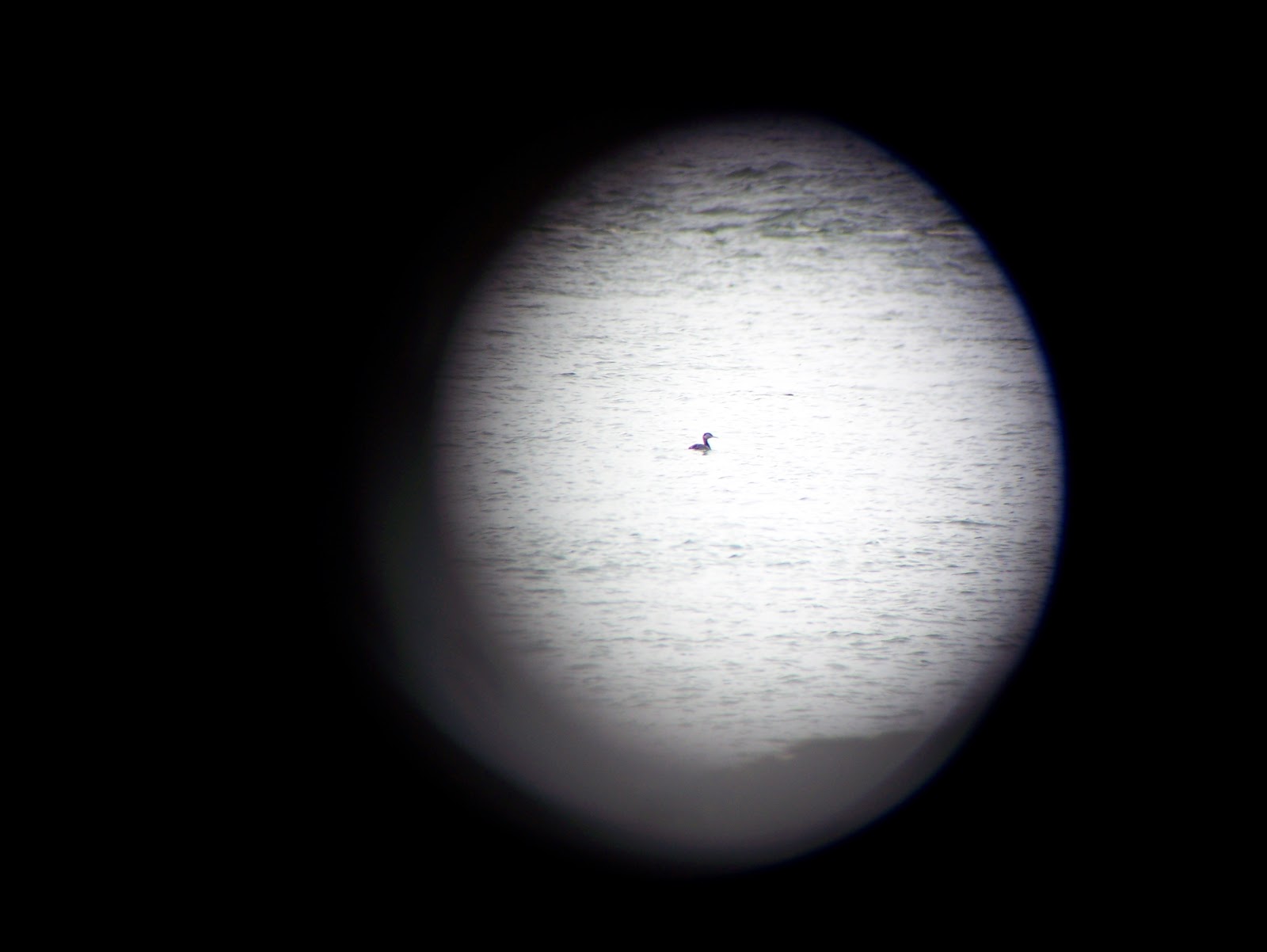
     There's very little to see in this photograph (don't blame me, the bird was a quarter mile away), but it's enough. Low profile, long neck: it's a grebe or cormorant. Huge white patch on face plus super-skinny yellowish beak: not a cormorant. There are 7 North American species of grebe, with varying lengths of necks and beaks. Let's do process of elimination again:
Horned Grebe: our bird's beak is too long.
Eared Grebe: our bird has too much white on the face.
Pied-billed Grebe: our bird's beak is way too long and skinny, and it's plumage has too many different colors for it to be a pied-billed.
Least Grebe: body proportions are all wrong. And it would freeze to death in Oregon.
Clark's Grebe: our bird's neck is too short, and it's completely dark.
Western Grebe: same as Clark's Grebe.
     The huge white triangle on the bird's face, with black on the forehead and a brownish neck, confirms our answer: this is a Red-necked Grebe (Podiceps grisegena), which I regard as quite possibly the most beautiful bird in the world. Macaws? Birds of Paradise? Tanagers? Get real. This bird wins with its sheer elegance and the richness of it's limited color palette. Unfortunately, I never got one to come close enough to get a good picture. So search the internet instead.

     As for the bird in the dark in Texas, Daniel was on the right track... sort of. This bird shares a lot in common with chickadees, namely the large head and grey/black/white overall coloration. But there are a couple of things that it doesn't share with chickadees, only a few of which can be noticed in the picture: It only has a black mask on its face, not a full black cap (you can see a bit of light grey over the eyes in the second picture). Chickadees like forests. There aren't many trees on the outskirts of San Antonio. This is a bird of dry, brushy areas.
     What you can't tell from the picture is that this cute, cardinal-sized puffball has a penchant for catching small animals and snapping their necks before impaling them on thorns so they dry up like beef jerky and can be eaten later. A bit of an oddity in the world, this is a predatory songbird. And I'm not talking about bugs; lots of songbirds eat bugs. No, the menu for this species' lunch occasionally includes frogs, lizards, snakes, mice, and even other birds. I present to you: the Loggerhead Shrike! (Lanius ludovicianus)
     The really odd thing, though, is that even though it seemed like there was one of these on every telephone wire in the area (there was one day I counted more of them than any other species besides Rock Dove and House Sparrow) I never actually got a good picture of one. Oh, well. Someday.

But remember, you still got points for trying! And keep an eye out for What Is It? Round 8, which will be easier.

Monday, November 12, 2012

The Coastal Challenge! (aka What Is It? Round 7)

     For those of you who tried last week's What Is It? challenge, go to the Lazuli Bunting page on Cornell University's All About Birds site and scroll down to the bottom so you can see the "similar species."
Yup. That was a Blue Grosbeak (Passerina caerulea). Congrats to Julia for her correct ID.
     No one got the bird in the dark correct (it is not a verdin, great kiskadee, or black-capped chickadee), so I've decided to give everyone a second week to answer that one. Here are a few hints regarding that particular bird:
     1. It is comparable to a northern cardinal in size
     2. The area it is in has a few trees, but most of the habitat is scrub
Answers for the bird in the dark are due on November 19th.

     Now get out those field guides and raincoats, because we're heading out to dreary shores of Garibaldi, Oregon for a waterbird extravaganza! It's time for...

The Coastal Challenge

    That's right... 5 photos, 7 species, and only 3 weeks to identify them all!
    But first, some general info on birding by the sea.
    Coastal areas are perhaps the best places for birding, especially in lagoons, tidal marshes, bays, and jetties. You can find hundreds of species in the same place: ducks, geese, grebes, loons, herons, sandpipers, plover, cormorants, pelicans, rails, falcons, eagles, gulls, terns, skuas, murres, auks, puffins, pipits, sparrows, blackbirds--the list goes on and on. Best of all, they tend to be out in the open and fairly easy to see (there's not much to hide them on the open water or along the shore).
     One of the best things for beginners about birds along the coast is that their daily schedule is not governed by the sun. For warblers and other migratory forest birds, you pretty much have to go birding really early in the morning to see them. Seabirds and shorebirds, however, go by the tides. You can go to a tidal marsh or jetty at high tide and it will be filled with diving ducks and grebes; if you visit the same location at low tide, the ducks will be gone and replaced with sandpipers and plover. If you are on vacation to the coast, consider visiting a beach near a wildlife refuge. Pay attention to the birds that fly by--not everything is a gull! In southern California you can find lots of terns, cormorants, pelicans, and sometimes even skimmers at popular state beaches.

    There are two problems with birding near the ocean:
1. We don't have any around here.
2. Waterbirds can be tough because of how far away they are from shore.

On that note, you'll have to use all of your birding ability to get these ID's. When you post your answers, identify which picture they go with. Remember, in order to get full points you must identify the species, not just family or genus. Ready? Have fun!

#1: Perched on a shipwreck near a clam processing plant...
Photo by the author.
#2: A trio out on the bay...
Photo by the author.
#3: The leftmost bird in the previous photo is tough... here's another view of it.
Photo by the author.
#4: More swimmers!
Photo by the author.
#5: This one was so far away it could only be photographed through a spotting scope...
Photo by the author.

Answers for the Coastal Challenge are due by Monday, December 10th.
(Yeah, I extended it again. Again.)

Happy identification!

Thursday, November 1, 2012

What Is It? (Round 6)

We had great turnout for last week's ID challenge!
Last week's birds were Gambel's Quail (Callipepla gambelii) and Sora Rail (Porzana caronlina)

David mentioned that the Sora's body looked a bit strange... and he's right! For one thing, they have huge feet that spread their weight out over soft mud so they don't sink in. If that's not weird enough, they have muscles that let them flatten their own ribcages so they are less than an inch and a half wide. This lets them dart quickly through dense reeds (trust me, they are really fast).

So now it's time for Round 6!

These two are fairly easy. I figured I'd give you a week to relax before... THE COASTAL CHALLENGE!
Yeah, next week will be a big one. So start studying your seabirds.

Okay, back to Round 6.
Since you guys have been so great at identifying things quickly, I've decided to do at least two species per week.

     Our first species here was out in a scrubby area near Lake Hodges in Escondido, California. Is he gorgeous, or what! (too bad the picture isn't all that great)
Photo by the author.
     Since I was discussing owls and looking at birds in the dark, I figured I'd let you guys try some of that too (the dark part, not the owl part). You can't see much detail on this guy from San Antonio, Texas, but you can still identify him! Both pictures were taken at around 9:00pm outside the hotel I was staying in.

Photo by the author.
     As usual, use the "view image" option to see these full size. Comments with answers are due by Thursday, November 8th. THE COASTAL CHALLENGE will open on November 9th (which just so happens to be my birthday).

Happy IDing!

Thursday, October 25, 2012

What Is It? (Round 5)

Note: make sure to read the post "Be Patient... Or Not" and try out the real-life birding challenge included there.

Congrats to Gloria and David on identifying last week's Yellow-rumped Warbler (and nice job considering subspecies)!

Note: If anyone needs a field guide during school hours, just ask me.

   So now on to Round 5; We've got some fun ones this time... birds that are hard to see--and even harder to photograph! Camouflage, thick vegetation, and fast movement make the birds here tough to get a good view of, so you'll have to identify them on minimum amounts of information. As usual, I highly recommend that you use "view image" too see these photos full-size. Ready? Answers for both species are due by Halloween (that would be October 31st)!

Our first species was on a mountainside near Tucson, AZ. The first step is finding the birds!
Photo by the author.
     The next three photos are all of the same bird in a marsh in South Padre Island, TX. The fact that it was evening and starting to get dark out didn't help my photography efforts.
My first attempt resulted in this: At least you can see its tail. Sort of.
Photo by the author.
 Argh! Got the whole bird, but it's blurry...
Photo by the author.
There! It's in focus! Got it! Well, at least its rear end is. And it's really dark. Oh, well.
Photo by the author.
Trust me, there is enough information in these photos to identify both species.

Have fun!


Wednesday, October 17, 2012

What Is It? (Round 4)

Two things of note to start off with:

1. Make sure to read the post "Be Patient... Or Not", which is an actual posty post and not one of these little ID challenges. It offers advice on how to see more birds if you have very little birding experience.

2. We've got a modifications to how "What Is It?" works: in order to be completely sure that everyone's' identifications are based off of their work and not just reading others' posts, once I see that you have commented with an answer I will mark it as "spam" and it will not be visible. Once that particular round of "What Is It?" is over, I will "unspam" all of the comments and they will be visible again.

Now with that out of the way,

Congrats to Gloria, David, Roberto, and Evan on their ID's of last week's Little Blue Heron (Egretta caerulea) and Tricolored Heron (Egretta tricolor)!

Once again, I will say that the Uni library has two bird field guides that you should make use of when trying to identify species. Also, I will have a field guide on hand during blog reading/writing days if you just can't be bothered to check one out from the library.

So on to round 4!
     This bird is a bit less distinctive than last week's herons. Get used to it. I'll be kicking the difficulty level up another notch next time.
Photo by the author.
     Anyway, this little guy was at a "water ranch" in Gilbert, Arizona in mid-March.
    
     You have until October 24th to post an ID of this bird.

Have fun!

Monday, October 8, 2012

What Is It? (Round 3)

Okay, I'll confess that Round 2 may have been a bit challenging. However, Gloria and Roberto both correctly identified the pair of Double-Crested Cormorants (Phalacrocorax auritus). I let it slide this time, but from now on it's your most recent answer that counts when I tally up the score at the end. Interestingly enough, there actually was a Neotropic Cormorant at Horicon while I was there a few years back, but these two are too big and not skinny enough to be the Neotropic (plus, there was only one Neotropic there).

No one correctly identified the third bird, but this one was especially hard for a number of reasons:
1: The photo doesn't show all that much detail
2: The bird is a juvenile.
3: It is a migratory raptor, and thus some range maps don't show it inhabiting Wisconsin
4: There are three different subspecies of this bird in the US, and they don't all look the same,
     4.5: and this guy/gal is not of the most common subspecies.

We had some guesses of Northern Harrier, which isn't half bad since this bird's color, speckling, and banded tail match that of a female Circus cyaneus. It's in the right habitat and location, too. It's even the right size. But it's not a harrier. I'll walk you through the identification:
Everyone seemed to get that it was a bird of prey based on its size and shape. After that, the most important identification feature of this bird is the face. Notice the really dark vertical stripe below the eye and the large white patch behind it. Harriers don't have facial patters as bold as that. That area of dark feathers is called a malar or moustachial stripe. This feature rules out all of the North American raptors except for falcons. Based on its size (approximated by comparing it to the cormorants) it has to be either Prairie, Peregrine, or Gyrfalcon. A gyr would be too dark and would not show up in Wisconsin unless it was a really bad winter and there wasn't enough food up north. This bird's color points towards Prairie Falcon... BUT WAIT!
The malar stripe is too large and dark for Prairie Falcon. And what would it be doing in the middle of a huge marsh? They eat mainly ground squirrels--which you aren't likely to find swimming. Horicon Marsh has lots and lots of waterfowl, which are perfect food for...
Peregrine Falcons!
Yup, this bird belongs to the fastest species on the planet. To be specific, this is a juvenile of the subspecies Falco peregrinus tundrius who was migrating south for the winter and happened to stop by in Wisconsin.

Okay, after all that... We move on to Round Three!!!
Photo by the author.
It's two species again, but this time you only have until October 15th to identify both... so start now!
This pair was spending their Spring Break in a tidal marsh in South Padre Island, TX. Once again, you can use "view image" to see it full size.

Have fun!

Monday, September 24, 2012

What Is It? (Round 2)

     Congratulations to Gloria on her correct identification of last week's Cape May Warber (Steophaga tigrina)!
     Here's this week's ID challenge:
photo by the author
     Hint: Click on the photo, then right-click and select "view image". This will let you zoom in and let you view it full size so you can get a good view of the birds. This odd trio was at Horicon Marsh in Wisconsin in late July. Try to ID both species, since they will be scored separately (see below).

     Some people have been wondering about prizes. Isn't knowing that you correctly identified the bird enough of a prize? Oh, fine. There will be prizes. Small ones. Maybe. And there is now a scoreboard for all-time top identifiers.

Here's how scoring works:
     You automatically get 1 point just for posting an answer (right or wrong)!
     The first correct answer gets 4 extra points.
     The second correct answer gets 2 extra points.
     Any later correct answers get 1 extra point.

     Since this week's challenge has two species, you can get a maximum of 10 points if you are the first to correctly identify both species.

     Have fun!

Sunday, September 16, 2012

What Is It? (Round 1)

     I decided that people who are not yet birders could use some practice identifying birds that sit still... which means birds in photographs. So here it is: What Is It, Round 1!
     Grab a field guide (if you don't own one, they're available at the library) and try to figure out what species this is a photo of. Post your answer as a comment. Please do not just copy other peoples' answers--that's cheating! Also, no random guessing! Spend some time considering its appearance, habitat, and behavior rather than jumping to conclusions. Remember, I want the name of the species, not just "it's a bird!" or "it's a yellow bird!"
photo by the author
     Hint: this cute little guy was flitting around in the conifers in my backyard (a.k.a. somewhere in central Illinois) during spring migration.
     The correct answer will be posted along with the next What Is It (expect 1-2 weeks between those... depends on how many good pictures I take).
     Have fun!